
Have you ever looked up at a clear night sky and felt small and huge at once, as if the stars were far away and somehow part of you? Carl Sagan captured that feeling in his 1980 series Cosmos: “The cosmos is within us. We are made of star-stuff. We are a way for the universe to know itself.” Science backs him up. The calcium in our bones and the iron in our blood were made inside stars that died long before our Sun was born.
Astrology carries the same idea into symbolism. From Babylonian priests charting the heavens to Greek philosophers writing about the “music of the spheres,” people have long believed that human life echoes the patterns of the sky. Every zodiac sign has its own link to the stars, but three have long been seen as especially tuned in to the universe as a whole: Pisces, Aquarius, and Sagittarius. Their myths, their ruling planets, and even their real positions in the night sky all point toward something vast.
Pisces: The Ocean That Remembers Everything
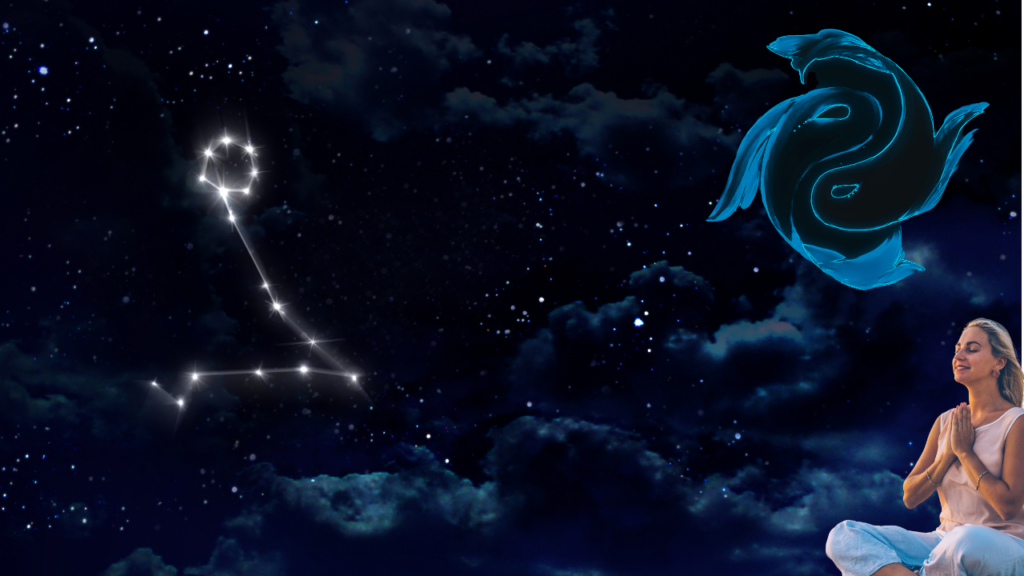
Pisces is the twelfth and final sign of the zodiac, and that position carries real weight. Aries opens the cycle with the spark of the individual self, and Pisces closes it by dissolving that self back into the whole. That is why astrologers call Pisces the “old soul” of the zodiac, a sign said to hold a little of every sign before it. Its symbol, two fish swimming in opposite directions but bound by a single cord, captures an ancient spiritual tension: we live in the physical world while longing for something beyond it. Pisceans are known for deep intuition and empathy, often sensing the mood of a room before anyone speaks. Mystics would call that a form of cosmic awareness.
The connection deepens with Neptune, Pisces’ modern ruling planet. Neptune wasn’t stumbled upon through a telescope. It was worked out on paper. In 1846, the French mathematician Urbain Le Verrier studied strange wobbles in the orbit of Uranus and calculated that an unseen planet must be tugging on it. On September 23 that year, Johann Galle at the Berlin Observatory pointed his telescope where Le Verrier said to look and found Neptune within about a degree of the prediction. It’s a perfectly Piscean story: a hidden world, sensed through its invisible pull before anyone could see it. Named for the Roman god of the sea, Neptune has come to symbolize dreams, imagination, and the boundless.
Pisces also holds a unique place in astronomy. Because of a slow wobble in Earth’s axis called the precession of the equinoxes, first described by the Greek astronomer Hipparchus in the second century BCE, the Sun’s position at the spring equinox drifts backward through the constellations, about one degree every 72 years. For roughly two thousand years, that point has sat in Pisces. The psychologist Carl Jung explored this “Age of Pisces” in his book Aion (1951), linking it to the religious symbolism of the era, including the fish as an early Christian emblem. For Jung, Pisces wasn’t just a birth sign. It was a window into humanity’s shared spiritual story.
Aquarius: The Visionary Who Speaks for the Stars
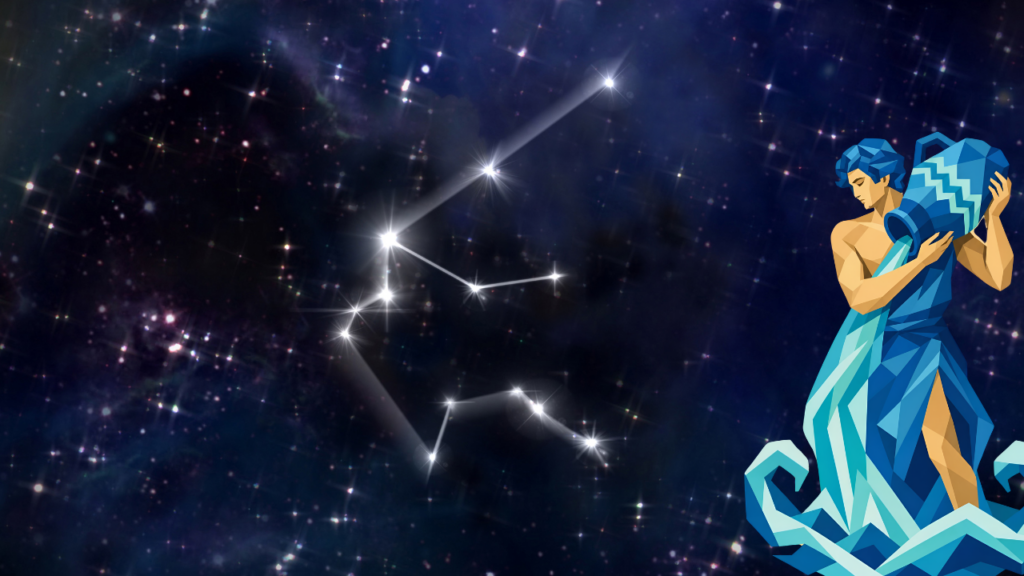
If Pisces feels the universe, Aquarius seeks to understand it. Aquarius is the Water Bearer, yet it is an air sign, and that contradiction is a clue. The water it pours isn’t ordinary water. It represents knowledge, spirit, and life itself, poured out for everyone. The Babylonians called this constellation GU.LA, “the Great One,” and linked it to Ea, god of wisdom and fresh waters, as historian Gavin White describes in Babylonian Star-lore. From its earliest roots, Aquarius was a figure bringing gifts from the heavens to humanity. Aquarians are often described as humanitarian, original, and ahead of their time, more concerned with the future of the species than the small dramas of daily life.
Uranus, Aquarius’ modern ruler, has a discovery story that fits the sign almost perfectly. On March 13, 1781, William Herschel, a musician turned astronomer who built his own telescopes, spotted an object that didn’t behave like a star. It became the first planet discovered in recorded history, and in one night it roughly doubled the known size of the solar system. Uranus even spins on its side, tilted about 98 degrees, as if refusing to follow the rules the other planets keep. In Cosmos and Psyche (2006), scholar Richard Tarnas calls Uranus the “Promethean” planet, after the Titan who stole fire from the gods and gave it to humankind.
This is why Aquarius is seen as the sign of cosmic consciousness. When the spring equinox point finally drifts from Pisces into Aquarius, sometime in the coming centuries by most astrological estimates, humanity is said to enter the “Age of Aquarius.” The phrase became famous in the 1960s, but the idea beneath it is much older: a time when people begin to see themselves as citizens of the universe rather than of a single tribe or nation. The typical Aquarian already lives a little in that future. They’re the friend reading about quantum physics at midnight, questioning every tradition, and thinking in terms of networks and the long arc of history.
Sagittarius: The Archer Aiming at the Heart of the Galaxy
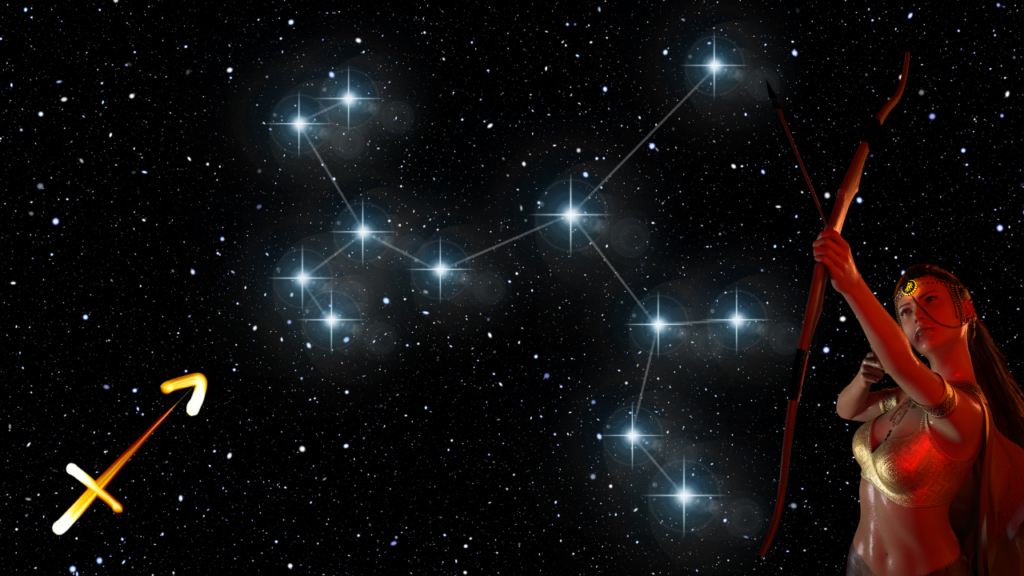
Sagittarius has the most literal claim of all, because it points straight at the center of our galaxy. Look toward the constellation Sagittarius on a dark summer night and you’re gazing toward the core of the Milky Way, about 26,000 light-years away. Hidden behind dense dust clouds sits Sagittarius A*, a supermassive black hole about four million times the mass of our Sun. In May 2022, the Event Horizon Telescope collaboration released the first image of it: a glowing ring of light around a dark center, captured by linking radio telescopes across the globe into one planet-sized eye. Our entire solar system orbits that point roughly once every 230 million years. The Archer’s arrow is aimed at the gravitational heart of our cosmic home.
Astrologically, Sagittarius is the seeker. It’s a fire sign ruled by Jupiter, the largest planet in the solar system, big enough to fit more than 1,300 Earths inside. Classical astrologers called Jupiter the “Greater Benefic,” the planet of expansion, wisdom, faith, and fortune, named for the king of the Roman gods. Sagittarians carry that expansive energy. They are the philosophers, travelers, and truth-seekers of the zodiac, always asking the big questions: Why are we here? What lies beyond the horizon?
The myth of Sagittarius ties it all together. The Archer is usually depicted as a centaur, half human and half horse, often linked with Chiron, the wise teacher of Greek heroes. The lower half represents our animal nature, rooted in the earth. The upper half, drawing a bow toward the sky, represents the part of us that reaches for meaning and the divine. It’s a portrait of being human in a vast universe: grounded in our bodies, yet always aiming higher. Sagittarians feel this pull strongly, a restlessness that isn’t about escape but a sense that something important is waiting out there.
Conclusion: The Universe Speaks in Many Voices
Pisces, Aquarius, and Sagittarius each connect to the cosmos in their own way. Pisces feels the universe, dissolving the line between self and everything else. Aquarius understands it, pouring out knowledge and vision. Sagittarius searches it, sending its arrow toward the true center of the Milky Way. One feels, one knows, one seeks, and together they sketch the full human relationship with the infinite.
Astrology is a symbolic language, not a science, and its value lies in reflection rather than prediction. Still, the stories behind these signs rest on real wonders: a planet found through mathematics, a sideways-spinning world that reshaped the solar system, and a black hole at the heart of our galaxy that we’ve now actually seen. Whatever your sign, the message is the same one Sagan gave us decades ago. We are not separate from the universe. We are part of it, made of its dust and lit by its fire.
So the next time you step outside on a clear night, look up and remember: the universe isn’t only above you. It’s within you, too.